Introduction
Agentic AI automation 2026 is redefining how businesses operate — and if you’ve been watching the AI landscape, one thing is unmistakably clear: AI agents are no longer a future concept — they are the operating system of modern business. From automating customer support to orchestrating multi-department workflows, agentic AI has moved from pilot projects to enterprise-wide deployment at a speed that is leaving unprepared businesses behind.
This post covers everything you need to know about the agentic AI revolution happening right now — the market data, the tools, the ROI, and the practical steps to implement AI automation in your business today.
What Is Agentic AI — And Why 2026 Is the Tipping Point
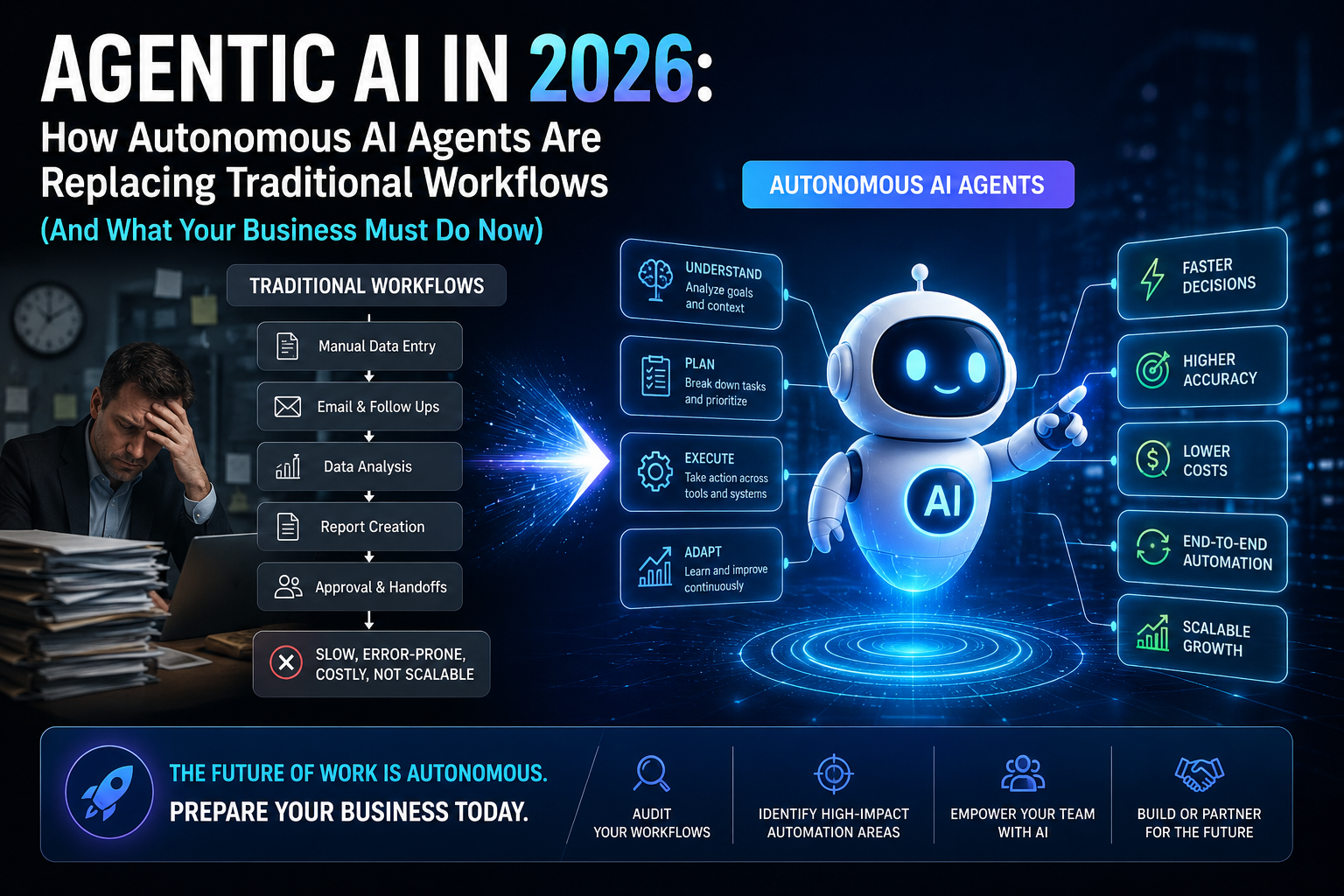
Agentic AI refers to AI systems that can understand, reason, plan, and execute tasks autonomously — without a human needing to direct every step. Unlike simple chatbots or rule-based automation, AI agents make decisions, coordinate with other agents, and handle complex multi-step workflows in real time.
The numbers tell the story:
- Gartner predicts 40% of enterprise applications will embed AI agents by end of 2026, up from less than 5% in 2025.
- The global AI agent market is valued at $10.91 billion in 2026 and is projected to reach $50.31 billion by 2030, growing at a 45.8% CAGR.
- McKinsey reports that 62% of organizations are either experimenting with or actively scaling AI agents — with 23% already deploying agentic systems across at least one core business function.
- A PwC survey of 300 U.S. executives found 79% of organizations already run AI agents in production, with 66% reporting measurable productivity gains.
The question is no longer whether to adopt AI automation. The question is how fast you can do it without falling behind.
How AI Agents Are Replacing Traditional Workflows in 2026
The shift from human-operated workflows to AI-operated workflows is accelerating across every major industry. Here’s where AI agents are generating the most significant impact right now:
1. Customer Service & Support
Salesforce CEO Marc Benioff confirmed that the company reduced roughly 4,000 customer-service positions after AI agents began handling approximately half of all customer interactions. The payback period for AI-driven customer service deployments averages just 4.1 months — the fastest ROI of any AI use case.
2. Finance & Procurement
AI agents handling invoice processing, vendor communications, purchase approvals, and financial reconciliation are delivering cost reductions of up to 70% in finance and procurement workflows. What once required a team of analysts can now be handled end-to-end by a multi-agent pipeline.
3. Human Resources & Onboarding
HR automation powered by AI agents is cutting employee onboarding cycle times by up to 80%. From document collection and compliance checks to benefits enrollment and training scheduling, AI agents handle the entire workflow without human intervention.
4. Sales & Lead Management
Sales teams deploying agentic AI — for lead scoring, outreach sequencing, follow-up automation, and CRM updates — are reporting 4x to 7x improvement in conversion rates. AI agents don’t forget follow-ups, never miss a lead signal, and operate 24/7.
5. Multi-Department Workflow Orchestration
In 2026, the most advanced enterprises are using multi-agent systems where separate AI agents coordinate across sales, supply chain, support, and finance simultaneously — orchestrating business operations with minimal human oversight.
The Top AI Automation Tools Dominating 2026
The automation tooling landscape has matured dramatically. Here are the leading platforms and where each fits:
Zapier — Best for Non-Technical Teams
Zapier remains the gold standard for ease of use, with 8,000+ app integrations and its newly launched Zapier Agents for autonomous task execution. If your team has no technical resources and just needs things to work quickly, Zapier delivers — though at a higher per-task cost.
Make (formerly Integromat) — Best Value for Growing Teams
Make offers 10,000 operations per month starting at $9, delivering 13x more value than Zapier at comparable tiers. Its visual workflow designer and Maia AI assistant (which builds automation scenarios from natural language) make it ideal for teams that want power without complexity.
n8n — Best for AI-First Technical Teams
n8n 2.0, launched January 2026, is the infrastructure play for serious AI automation. It ships with native LangChain integration, 70+ AI nodes, sandboxed code execution, persistent agent memory, and full data sovereignty through self-hosting. Critically, n8n charges per execution rather than per task — meaning a 200-step AI pipeline costs the same as a 2-step workflow, making it exceptionally cost-efficient at scale.
Relevance AI — Best for Autonomous Agent Deployment
For teams that need genuinely autonomous agents that think and adapt — not just trigger-action workflows — Relevance AI provides the premium platform designed for deploying AI workers that handle open-ended tasks without predefined logic paths.
The Real ROI of AI Automation: What the Data Says
The business case for AI automation in 2026 has never been stronger — or more measurable:
- Average ROI across agentic AI deployments: 171%
- U.S. enterprises average 192% ROI, exceeding traditional automation ROI by 3x
- Companies that invest in governance frameworks and baseline metrics before deployment reach positive ROI 2.4x faster than those that don’t
- The AI agent market CAGR is 45.8% — the fastest-growing enterprise technology segment
However, there’s an important caveat: 19% of AI agent deployments never reach payback at all. The difference between successful and failed deployments comes down to preparation — clear use case definition, proper data access, integration planning, and change management.
The Workforce Reality: Augmentation vs. Displacement
It would be incomplete to discuss AI automation without addressing the workforce impact honestly.
The World Economic Forum has estimated that AI will displace approximately 85 million jobs by 2026 — but simultaneously create new categories of work. BCG’s latest research frames it clearly: AI will reshape more jobs than it replaces. The pattern most organizations are following isn’t mass layoffs — it’s attrition without backfill, quietly reducing headcount as AI agents absorb the workload of departing employees.
For workers: 31% have refused to use AI tools at work, according to a 2026 study — a figure that highlights why change management is as critical as technology deployment.
For businesses: The entry-level talent pipeline is being disrupted the most, as AI agents absorb routine analytical, administrative, and customer-facing tasks that once served as career entry points.
5 Practical Steps to Implement AI Automation in Your Business Right Now
You don’t need a massive budget or a dedicated AI team to start. Here’s the framework:
Step 1: Identify your highest-friction workflows. Map out the repetitive, rule-based, or data-heavy processes consuming the most human hours. Customer inquiry triage, data entry, invoice processing, and lead follow-up are common starting points.
Step 2: Choose the right platform for your team. Non-technical team? Start with Zapier or Make. Technical team building for scale? Evaluate n8n. Need fully autonomous agents? Consider Relevance AI or Microsoft Copilot Studio.
Step 3: Start with a single high-ROI use case. Customer service automation offers the fastest payback (4.1 months). Build confidence and internal buy-in before expanding to more complex multi-agent orchestration.
Step 4: Establish governance before you scale. Define who owns AI outputs, set accuracy benchmarks, build in human review checkpoints for high-stakes decisions, and document your agent logic. Companies that do this reach positive ROI 2.4x faster.
Step 5: Measure, iterate, and expand. Track time saved, error rates, conversion improvements, and cost reduction. Use that data to justify expansion into additional workflows and departments.
What’s Coming Next: The 2026–2027 Horizon
The next wave of AI automation development is already underway:
- “Trust by Design” architecture — security, compliance, and governance baked into AI agent systems from the ground up, rather than audited after deployment
- Low-code/no-code agent builders — making agentic AI accessible to operations teams without any engineering involvement
- Persistent agent memory — AI agents that remember context across sessions, building institutional knowledge over time
- Cross-organizational agent networks — AI agents from different companies collaborating on shared workflows (supply chain, logistics, financial settlement)
The companies building these capabilities into their operations today will hold a structural competitive advantage that will be extremely difficult to close two years from now.
Final Thoughts
The agentic AI automation in 2026 is not on the horizon — it’s already here. With a $10.91 billion market, 171% average ROI, and 40% of enterprise apps embedding agents by year’s end, the window to implement AI automation while gaining competitive advantage is narrowing fast.
Whether you’re a solopreneur looking to reclaim 10 hours per week or an enterprise architect redesigning how work flows across your organization, the tools, data, and playbooks exist today to make it happen.
The only remaining question is: how soon will you start?
Stay ahead of the AI automation curve. Follow us for weekly insights on the tools, strategies, and real-world case studies reshaping the future of work.