AI Project Management 2026: The Rise of the Agentic PMO
AI Project Management 2026 marks a turning point for organizations worldwide. The project management landscape has crossed a threshold with no turning back. As of mid-2026, autonomous AI agents have evolved beyond experimental pilot programs to become the operational backbone of Project Management Offices (PMOs) across industries.
The title “Project Manager” isn’t disappearing—but the role has fundamentally changed. Today’s project managers are no longer expected to spend most of their time creating schedules, assigning tasks, or chasing status updates. Instead, AI agents handle planning, resource allocation, progress monitoring, risk detection, and real-time course correction with unprecedented speed and accuracy.
Welcome to the era of the Agentic PMO, where AI Project Management 2026 is redefining how projects are delivered. Human project managers are shifting their focus toward strategic leadership, stakeholder alignment, business outcomes, and the complex decisions that require critical thinking, creativity, and sound judgment. Organizations that embrace this AI-powered transformation are setting a new standard for efficiency, agility, and project success.
What Is an Agentic PMO?
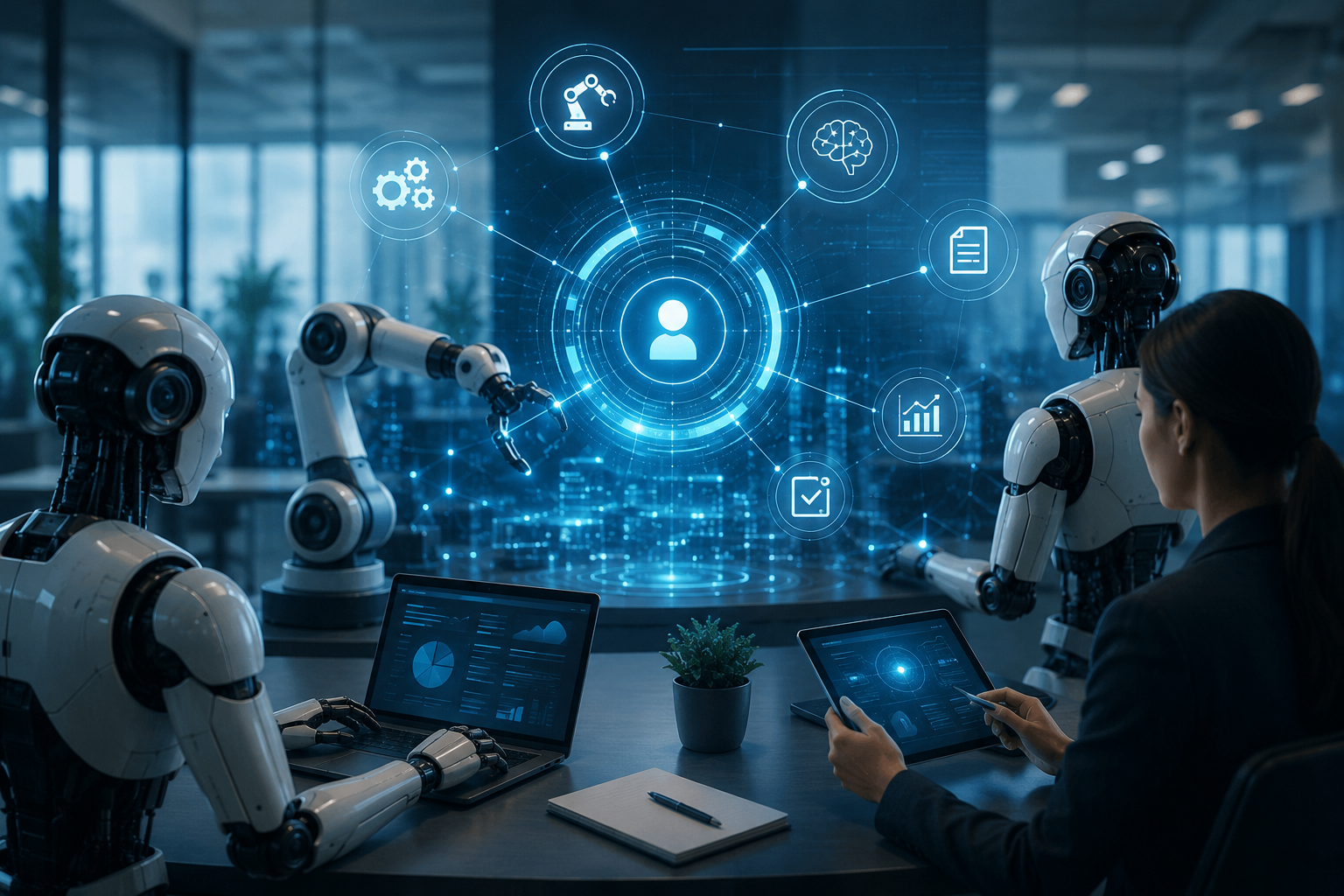
One of the defining trends in AI Project Management 2026 is the emergence of the Agentic Project Management Office (Agentic PMO). Unlike traditional PMOs that rely on human oversight and manual coordination, an Agentic PMO is powered by a coordinated network of autonomous AI agents, each responsible for a specialized operational role—such as resource planning, risk monitoring, timeline optimization, stakeholder communication, and status reporting.
These AI agents do more than analyze dashboards or display project data—they take action. Rather than waiting for a project manager to identify a bottleneck, they continuously monitor project activity, detect potential issues, evaluate available resources, communicate with relevant team members, reassign tasks when necessary, and optimize project schedules in real time. In many cases, these adjustments happen before a human project manager even opens the dashboard.
The business impact is already becoming clear. Research published in early 2026 shows that organizations deploying agentic project management systems are reporting 20–40% reductions in coordination overhead, with nearly two-thirds of early adopters experiencing measurable improvements in productivity, delivery speed, and operational efficiency.
This transformation is more than another software upgrade—it represents a fundamental shift in how projects are managed. Gartner projects that by 2030, as much as 80% of traditional project management work could be automated. AI Project Management 2026 demonstrates that this transition is no longer a future prediction; it is already reshaping how modern PMOs operate today.
The Five Forces Reshaping AI Project Management 2026
1. Autonomous Task Allocation and Resource Balancing
One of the biggest advances in AI Project Management 2026 is the shift from manual resource planning to autonomous resource optimization. Modern AI-powered capacity planning tools use predictive analytics to forecast demand, balance workloads, and optimize resource allocation across multiple concurrent projects in real time.
For example, ClickUp introduced AI Super Agents with cross-workspace automation and persistent memory in April 2026, enabling automated resource rebalancing that continuously adapts to changing project priorities. Likewise, Asana’s Smart Status analyzes task completion patterns, timeline deviations, and project activity to generate accurate health reports automatically, saving project managers an estimated 20–30 minutes per project each week.
2. Predictive Risk Management
The costliest project risks are often the ones that remain invisible until it is too late. In AI Project Management 2026, reinforcement learning agents continuously monitor project KPIs, detect emerging risks, and intervene as soon as performance deviates from predefined thresholds. These agents can recommend schedule adjustments, trigger targeted notifications, and escalate issues only when human approval is truly required.
This transforms risk management from reactive firefighting into proactive decision-making, allowing organizations to address potential problems before they affect budgets, timelines, or customer outcomes.
3. Hybrid Project Methodologies at Scale
Traditional debates over Agile versus Waterfall are giving way to AI-powered hybrid project management. Instead of forcing teams into a single framework, AI dynamically combines predictive and agile methodologies based on real-time project conditions.
The AI orchestration layer can adjust sprint cadences, modify milestone checkpoints, recommend governance changes, or shift delivery strategies as project complexity evolves. According to the 2026–2027 State of Agile report from APMIC, high-performing teams are moving beyond measuring velocity alone and placing greater emphasis on customer outcomes, business value, and measurable results.
4. AI-Native Collaboration and Communication
Another defining characteristic of AI Project Management 2026 is autonomous collaboration. Platforms such as Taskade now operate AI agents on scheduled workflows that automatically monitor overdue tasks, generate daily standup reports, send stakeholder updates, and identify blockers without requiring manual input.
Beyond text automation, AI agents can summarize meeting recordings, extract action items, update project boards, assign follow-up tasks, and synchronize changes across connected business applications within minutes. The traditional project dashboard is rapidly evolving into a command center for supervising an intelligent digital workforce.
5. Managing the “Silicon Workforce”
Perhaps the most significant long-term shift is the rise of managing AI agents as part of the workforce. Enterprise project leaders are increasingly expected to define AI agent responsibilities, establish escalation policies, audit AI-generated decisions, and build effective governance models that balance automation with human oversight.
As operational work becomes increasingly automated, the role of the project manager continues to evolve. Success in AI Project Management 2026 depends less on manually coordinating tasks and more on orchestrating collaboration between people and intelligent systems. Strategic thinking, stakeholder leadership, ethical oversight, and sound decision-making are becoming the defining skills of the next generation of project managers.
The Governance Gap: The Challenge No One Wants to Talk About
While AI Project Management 2026 is transforming how organizations deliver projects, it is also exposing a critical weakness: governance. The adoption of autonomous AI agents has accelerated far faster than the policies, controls, and accountability frameworks needed to manage them responsibly.
According to AvePoint’s 2026 State of AI report, 88.4% of organizations experienced at least one AI agent-related security incident during the past year. Many of these incidents were linked to unsanctioned AI agent deployments, excessive permissions, poor oversight, and unclear lines of accountability.
The challenge is only becoming more urgent. With the global AI project management market projected to reach $52.62 billion by 2030, growing at a 46.3% compound annual growth rate (CAGR), organizations are racing to deploy intelligent automation faster than governance practices can mature.
Forward-thinking Project Management Offices (PMOs) recognize that successful AI adoption requires more than advanced technology. They are establishing clear governance frameworks that define AI agent roles, decision-making authority, audit trails, security controls, compliance requirements, and human escalation protocols. These safeguards ensure that AI operates transparently, ethically, and within organizational policies.
In AI Project Management 2026, competitive advantage will not belong solely to organizations that automate first—it will belong to those that combine innovation with strong governance. The PMOs that build trustworthy, well-governed AI ecosystems today will be better positioned to reduce risk, strengthen compliance, and scale intelligent project delivery with confidence.
What Project Managers Should Do Right Now
The shift to AI Project Management 2026 is already underway. The question is no longer whether AI will become part of project management—it is whether you will learn to lead alongside it. To stay competitive, project managers should focus on four priorities.
Audit Your Project Management Technology
Start by reviewing your current project management stack. Many leading platforms—including ClickUp, Asana, Wrike, and Taskade—already include AI agents and intelligent automation features that many organizations have yet to activate. Before investing in new software, make sure you are fully using the AI capabilities you already have.
Build AI Literacy
Modern project managers do not need to become software developers, but they do need to understand how AI agents work. Learn how agents interpret instructions, where they are most likely to make mistakes, how to write effective prompts, and how to design workflows that produce accurate, reliable, and consistent results. AI literacy is quickly becoming a core leadership skill.
Redefine Your Value Around Human Judgment
As AI takes over routine coordination, scheduling, reporting, and documentation, your greatest value will come from the work machines cannot easily replicate. Focus on stakeholder relationships, strategic planning, organizational priorities, ethical decision-making, negotiation, and managing change. These human-centered capabilities will increasingly differentiate exceptional project leaders.
Establish Governance Before Problems Arise
Do not wait for an AI-related incident to define your governance strategy. Create clear policies that specify which decisions AI agents can make autonomously, which actions require human approval, how AI-generated decisions will be reviewed, and how audit trails will be maintained. Strong governance will help organizations scale AI responsibly while reducing security, compliance, and operational risks.
Project managers who embrace AI Project Management 2026 will not be replaced by AI—they will be empowered by it. The professionals who combine strategic leadership, strong governance, and AI fluency will be the ones best positioned to lead the next generation of high-performing, AI-enabled project teams.
The Bottom Line
AI Project Management 2026 is no longer a vision of the future—it is the new operating model for high-performing organizations. The rise of the Agentic PMO demonstrates how autonomous AI agents can manage planning, resource allocation, risk monitoring, reporting, and workflow optimization with a speed and precision that traditional manual processes cannot match.
The role of the project manager is not disappearing; it is evolving. The professionals who are succeeding in this new era are those who have shifted their focus from administrative coordination to strategic leadership, stakeholder engagement, governance, and informed decision-making. As AI takes on repetitive operational work, human expertise becomes even more valuable where judgment, ethics, creativity, and business context matter most.
The technology is mature. Enterprise adoption is accelerating. Competitive expectations are rising. Organizations that invest in AI Project Management 2026 today will be better positioned to deliver projects faster, improve collaboration, reduce risk, and adapt to an increasingly AI-driven business environment.
The question is no longer whether AI will transform project management—it already has. The real question is whether your PMO will lead this transformation or struggle to catch up.
Further Reading:
- How AI Agents Are Rewriting Project Management in 2026 (Autonomous PMOs Explained) — TechPlusTrends
- AI-Driven Project Management in 2026: Autonomous Planning, Workload Balancing, and Real-Time Workflows — Applying AI
Want to learn more about web development? Click here to explore our latest guides, tutorials, and expert insights.