The digital marketing 2026 playbook has been torn up and rewritten — again. But this time, the changes aren’t incremental. They’re structural. If your 2026 marketing strategy looks anything like your 2024 strategy, you’re already behind.
Here’s what’s actually happening in the market right now: **75% of marketers are using at least one form of AI** — predictive, generative, or agentic. The global social commerce market has hit **$1.66 trillion**. Third-party cookies are completely gone. And the brands winning in 2026 are those who pivoted early to first-party data, hyper-personalization, and AI-driven campaign orchestration.
This post breaks down the digital marketing strategies delivering real ROI right now — not theory, not predictions, but what’s working in today’s market.
1. Agentic AI Is Replacing Campaign Managers — Not Creatives
The narrative around AI and marketing has matured. We’re no longer talking about AI writing your captions or generating your imagery (though it still does both). In 2026, Agentic AI — autonomous systems capable of making multi-step marketing decisions without constant human oversight — is the real game-changer.
These AI agents are now:
- Optimizing campaigns in real time, pausing underperforming ad sets and reallocating budget to high-converting creatives automatically
- Personalizing email sequences based on behavioral signals, not just demographic segments
- Running A/B tests at scale, reaching statistical significance in hours instead of weeks
- Managing cross-channel bid strategies across Meta, Google, TikTok, and programmatic simultaneously
The global AI marketing market hit $47.32 billion in 2026 and is projected to reach $107.5 billion by 2028, growing at 36.6% annually. This isn’t a trend — it’s a category shift.
What this means for your business: Brands that use AI as a pure execution tool are doing fine. Brands that use AI as a strategic layer — making decisions, not just executing them — are growing 3x faster.
2. Hyper-Personalization at Scale Is No Longer Optional
“Personalization” used to mean putting a customer’s first name in a subject line. In 2026, that’s embarrassing.
True hyper-personalization means every touchpoint — email, ad, landing page, push notification, chatbot response — is dynamically tailored to an individual’s real-time behavior, context, and intent. Not their segment. Not their cohort. Them.
The numbers are stark:
- 48% of marketing leaders exceeding revenue goals cite advanced personalization as the primary driver
- Organizations with mature first-party data programs achieve 2.9x higher revenue growth than those relying on third-party data
- Brands delivering individualized experiences see measurably higher retention, LTV, and repeat purchase rates
The technology enabling this is the Customer Data Platform (CDP). If you don’t have a CDP unifying your customer data in 2026, you are not competing. You are guessing.
The personalization maturity model in 2026:
- Segment-based personalization (table stakes)
- Behavioral triggers (good)
- Real-time contextual personalization (competitive)
- Predictive + intent-based personalization at the individual level (winning)
3. Short-Form Video + Social Commerce = The Highest ROI Format in Marketing
Short-form video is not a social media strategy. It’s your top, middle, and bottom-of-funnel content engine — all in one format.
In 2026, the data is unambiguous:
- Short-form video delivers the highest ROI of any content format for both B2C and B2B marketers
- Social networks now account for 15.2% of all online sales globally
- 81% of consumers report being influenced to make spontaneous purchases through social media
- 50% of TikTok users have made a purchase immediately after watching a live shopping session
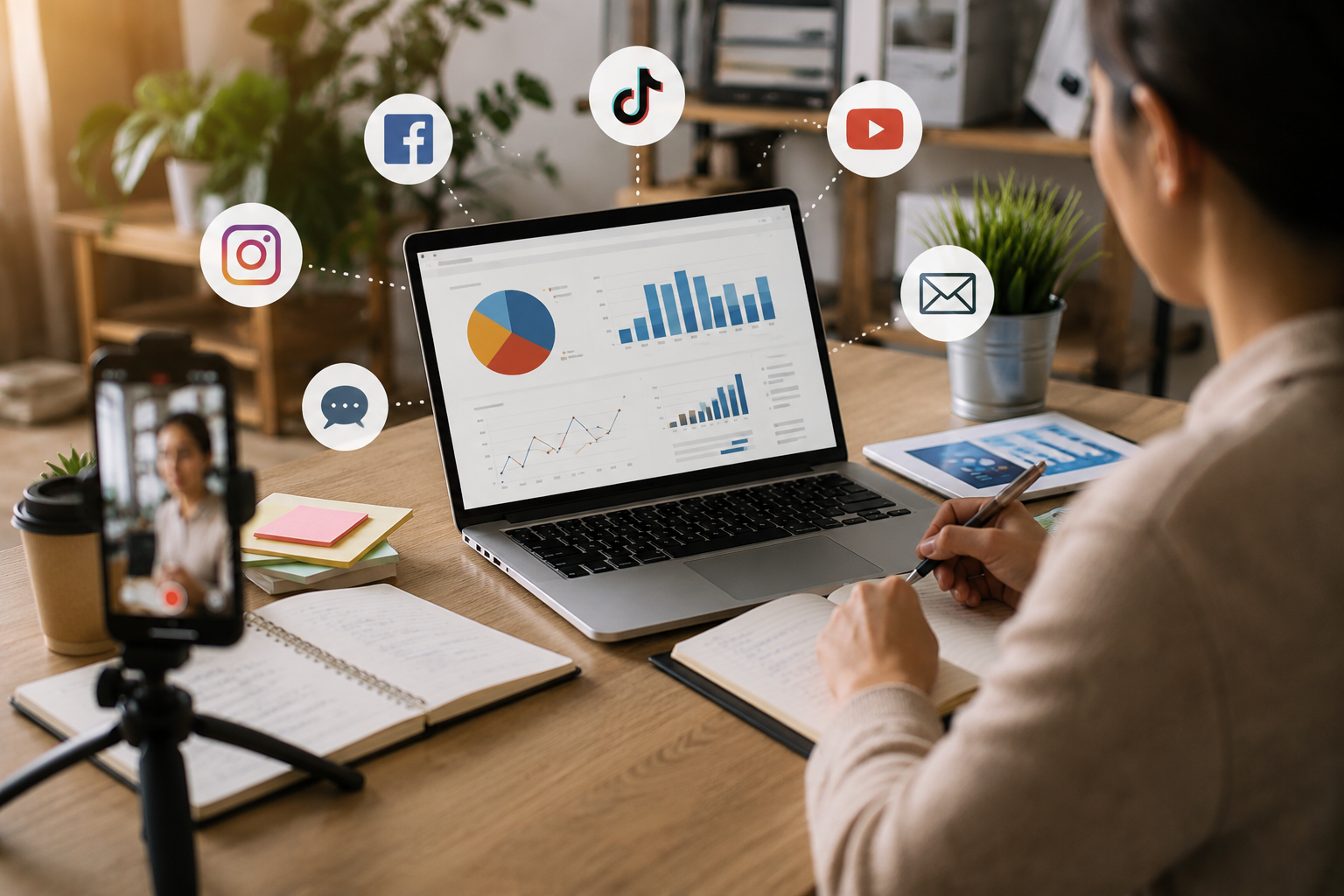
TikTok Shop, Instagram Checkout, and YouTube Shopping have collapsed the distance between discovery and purchase. Your video content is now a direct sales channel, not just a branding vehicle.
The short-form video funnel that converts in 2026:
- Top of funnel: Hook-driven content (first 1.5 seconds), trend participation, fast brand storytelling
- Middle of funnel: Social proof content, customer testimonials, behind-the-scenes, educational how-tos
- Bottom of funnel: Shoppable clips, limited-time offers, creator collaborations with native checkout
The brands winning on short-form video aren’t the ones with the biggest production budgets. They’re the ones posting consistently, authentically, and with a commerce-first mindset.
4. First-Party Data Is Now Your Only Durable Marketing Asset
Third-party cookies are gone. Across all major browsers. Permanently.
If your targeting, attribution, and audience-building were built on third-party data infrastructure, you’ve already lost measurement fidelity. The window to fix this is now.
First-party data advantages in 2026:
- Fully CPPA-compliant (California Privacy Protection Act, effective Jan. 1, 2026)
- More accurate because it comes from direct customer interactions
- More durable — you own it, platforms can’t take it away
- 2.9x higher revenue growth for brands who’ve made the transition
The essential tech stack for first-party data marketing today:
- CDP (Customer Data Platform) — unify all customer touchpoints into a single profile
- Consent Management Platform (CMP) — track permissions and stay compliant
- Server-Side Tracking — the most impactful technical investment you can make this year
- Privacy-first analytics — GA4 alternatives that don’t rely on third-party cookies
The formula: Zero-party data (explicit preferences) + First-party data (behavioral signals) + AI analysis = Better targeting than you ever had with third-party cookies.
5. Generative Engine Optimization (GEO) Is the New SEO
Google Search is no longer the only search. In 2026, consumers are using ChatGPT, Gemini, Perplexity, and Claude to answer buying questions, research products, and make decisions. These AI engines don’t serve the same results as traditional SERP. They synthesize, summarize, and cite sources they deem authoritative.
This creates a new discipline: Generative Engine Optimization (GEO) — optimizing your content not just to rank in Google, but to be cited, referenced, and summarized by large language models.
GEO strategies that are working right now:
- Structured, factual content with clear claims and data points that AI engines can extract and cite
- E-E-A-T signals (Experience, Expertise, Authoritativeness, Trustworthiness) are now evaluated by both Google and AI crawlers
- Brand mentions across authoritative third-party sites — the more trusted sources reference you, the more LLMs trust you
- Answer Engine Optimization (AEO) — formatting your content to directly answer the questions your audience is asking in conversational queries
- Long-form, topic-authority content that comprehensively covers subjects, not thin keyword-stuffed pages
The mindset shift: Stop asking “How do I rank #1 on Google?” Start asking “How do I become the source that AI cites when someone asks about my category?”
6. Omnichannel Is Dead. Unified Commerce Is What Comes Next
In 2026, the biggest structural change in digital marketing is the collapse of traditional channel boundaries. Search, social, video, shopping, email, and AI assistants are no longer separate channels with separate strategies. They are one fluid ecosystem where your customer moves without thinking about channels at all.
What brands call “omnichannel” today is usually just multi-channel with some coordination. What actually wins is Unified Commerce — a single customer experience that adapts based on where the customer is in their journey, regardless of channel.
The practical difference:
- Multi-channel: You’re on Instagram AND email AND Google
- Omnichannel: Those channels talk to each other
- Unified Commerce: The customer gets one seamless experience, and your data, messaging, and inventory are all one unified system
Brands executing Unified Commerce in 2026 are seeing measurably better customer retention, higher LTV, and lower customer acquisition costs than those running siloed channel programs.
The Digital Marketing Strategy Framework for 2026
If you’re rebuilding or auditing your marketing strategy this year, start here:
Foundation:
- Build a first-party data infrastructure (CDP + CMP + server-side tracking)
- Establish zero-party data collection through quizzes, surveys, and preference centers
- Audit your consent and privacy compliance against CPPA and any regional regulations
Content Engine:
- Commit to short-form video as your primary organic content format
- Build a content flywheel: short-form → repurpose into long-form → repurpose into newsletters
- Optimize all content for both Google SERP and AI engine citation (GEO + AEO)
Growth Channels:
- Activate social commerce on at least two platforms (TikTok Shop + Instagram Checkout minimum)
- Use AI-powered paid media tools for real-time budget optimization
- Build creator partnerships focused on authentic storytelling, not scripted ads
Measurement:
- Shift from last-click attribution to data-driven attribution models
- Implement server-side tracking to restore measurement accuracy
- Use AI analytics tools to surface insights, not just dashboards
What Separates the Brands Winning in Digital Marketing 2026
The brands growing fastest right now share three characteristics:
- They treat data as infrastructure, not reporting — their first-party data isn’t just in dashboards, it’s actively powering personalization, targeting, and product decisions in real time.
- They use AI for leverage, not replacement — AI handles execution at scale; humans focus on strategy, brand voice, and creative direction. The combination is unbeatable.
- They build for trust, not just traffic — in a world of AI-generated content, algorithmic feeds, and privacy regulations, the brands that win are the ones consumers actually trust. Authentic content, transparent data practices, and genuine community building are competitive advantages now.
The digital marketing landscape in 2026 is more complex than ever — but the principles haven’t changed. Understand your customer. Show up where they are. Give them value before you ask for anything. Build trust over time.
The tools and channels are new. The strategy is timeless.
Key Takeaways
- Agentic AI is automating campaign management — shift from execution to strategy
- Hyper-personalization at the individual level (not segment level) drives 2.9x revenue growth
- Short-form video + social commerce is the highest ROI format in 2026 — the $1.66T market proves it
- First-party data is your only durable targeting asset after the death of third-party cookies
- GEO (Generative Engine Optimization) is the new SEO — optimize to be cited by AI, not just ranked by Google
- Unified Commerce beats omnichannel — build one seamless customer experience across all channels