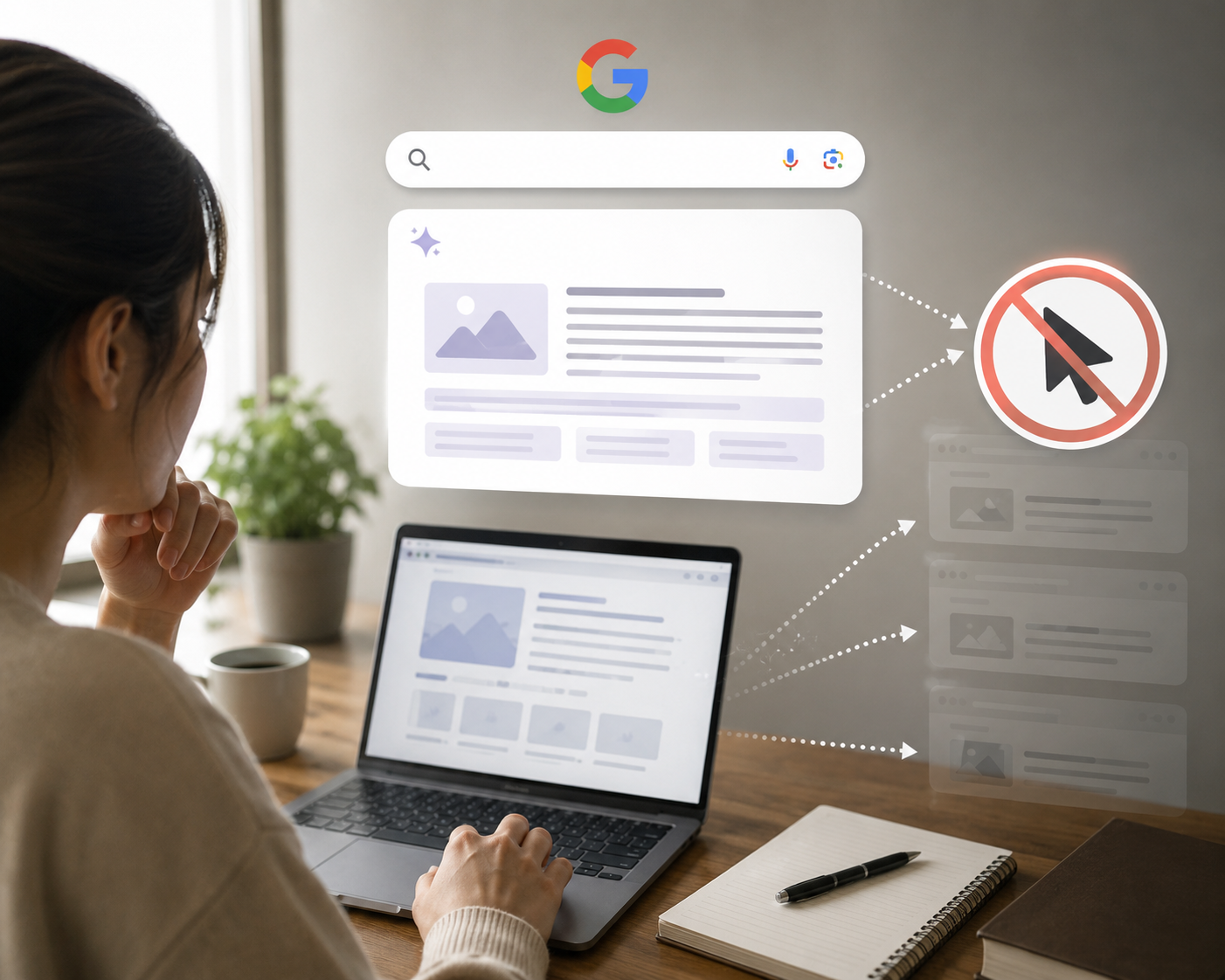
If your SEO strategy is still focused primarily on keyword rankings, you’re measuring success using standards from a search landscape that has fundamentally changed. In 2026, Google AI Mode and AI Overviews have transformed how users find information, appearing in approximately 48–60% of Google searches and reaching more than 2 billion monthly users worldwide. At the same time, an estimated 83% of searches now end without a click to any website, making visibility more important than rankings alone.
The rules of search have evolved. Success is no longer determined solely by where your pages rank but by whether your content is trusted, cited, and surfaced within Google’s AI-powered search experience.
In this guide, you’ll learn what SEO in the Age of Google AI Mode really means, how the latest changes are reshaping organic search, why traditional SEO signals are becoming less influential, and the practical strategies you can use to maintain visibility, build authority, and thrive in Google’s AI-first search ecosystem.
The Numbers That Should Alarm Every SEO Professional
The shift to SEO in the Age of Google AI Mode is backed by data that every marketer should pay attention to. When a search triggers an AI Overview, the average organic click-through rate drops from 1.76% to 0.61%—a 61% decline. At the same time, Google AI Mode queries are becoming more conversational, averaging three times longer than traditional searches. Follow-up queries have increased by 40% month over month, while AI Mode now serves more than 1 billion monthly users, with adoption continuing to grow rapidly.
Despite these changes, there is a significant opportunity. Websites cited within AI Overviews receive 35% more organic clicks and 91% more paid clicks compared to competitors that are not referenced. In SEO in the Age of Google AI Mode, success is no longer defined solely by earning the #1 ranking. The new objective is to create authoritative, trustworthy content that Google’s AI is confident enough to cite and recommend.
Why Your Rankings No Longer Predict AI Visibility
The latest research on SEO in the Age of Google AI Mode reveals one of the biggest shifts in search optimization. Nearly 47% of AI Overview citations now come from pages ranking below position #5, showing that the connection between traditional SERP rankings and AI-generated citations has weakened dramatically over the past year.
This change is redefining SEO in the Age of Google AI Mode. Google’s March 2026 core update was one of the most volatile in recent years, with nearly 80% of top-three rankings changing and about 24% of pages that previously ranked in the top 10 dropping out altogether. The May 2026 core update, which completed its rollout on June 2, reinforced the same trend.
For businesses and marketers focused on SEO in the Age of Google AI Mode, the message is clear: Google is shifting its ranking systems toward semantic completeness, entity authority, structured data, and content quality rather than relying primarily on keyword density and backlink volume. Creating authoritative, comprehensive, and well-structured content is now essential for earning visibility in both AI Overviews and traditional search results.
The Three-Layer Strategy: SEO + AEO + GEO
SEO in the Age of Google AI Mode combines three essential strategies. Traditional SEO (Search Engine Optimization) builds your site’s authority and visibility, AEO (Answer Engine Optimization) helps AI systems understand and extract your content, and GEO (Generative Engine Optimization) positions your content as a trusted source for AI platforms like Gemini, ChatGPT, and Perplexity. Mastering all three is the key to long-term success in SEO in the Age of Google AI Mode.
SEO (Search Engine Optimization) remains the foundation. It establishes baseline crawlability, site authority, and topical relevance. Don’t abandon it — it’s still table stakes.
AEO (Answer Engine Optimization) structures your content so AI systems can extract direct answers. This means question-based headings, concise answers in the first paragraph, FAQ schema markup, and server-side rendering to ensure AI crawlers see your content. Critically, verify that bots like Googlebot-Extended and GPTBot are not blocked in your robots.txt.
GEO (Generative Engine Optimization) is the newest layer — and the most powerful for long-term AI visibility. GEO is the practice of positioning your content as a trusted citation source for large language models like Gemini, ChatGPT, Perplexity, and Claude. Research shows specific content tactics that measurably improve citation rates: adding expert quotes increases citation likelihood by 41%, including statistics by 30%, and using inline citations by another 30%. LLMs preferentially cite content with original data — proprietary surveys, first-party benchmarks, unique case study metrics — because it cannot be found elsewhere.
What Google’s AI Ranking System Actually Evaluates
Google’s AI Mode ranking is governed by a multi-layered set of signals. Here’s what the data shows matters most:
Semantic Completeness is the single strongest predictor of AI Overview selection (r = 0.87). Analysis of nearly 16,000 AI Overview results found that content scoring 8.5/10 or higher on semantic completeness is 4.2 times more likely to appear in AI Overviews. This means answering a topic exhaustively, not just targeting a single keyword.
E-E-A-T (Experience, Expertise, Authoritativeness, Trustworthiness) is now a direct citation signal, not just a quality guideline. Author credentials, first-hand content, third-party mentions, and site-level trust signals all factor into whether your content gets surfaced. Google’s AI systems use E-E-A-T to assess source credibility before including any page in a generated response.
Multi-Modal Content dramatically improves selection rates. Pages that combine text, images, videos, and structured data show 156% higher AI Overview citation rates compared to text-only content.
Structured Data / Schema Markup remains a strong eligibility signal. Pages with valid FAQPage, HowTo, Article, and Organization schema consistently appear in AI citation results at higher rates than unstructured pages.
The First 200 Words Rule: AI systems that use real-time retrieval — including Google AI Overviews and Perplexity — evaluate page relevance primarily on opening content. Your first 200 words should directly and completely answer the primary query.
According to Google’s own AI Optimization Guide, optimizing for generative AI search is still SEO — AEO and GEO are not separate disciplines but extensions of the same practice. Google explicitly states you can ignore gimmicks like “content chunking,” llms.txt files, and AI-specific rewriting.
The Multi-Platform Reality of Search in 2026
Google is no longer the only search platform that matters for visibility. ChatGPT, Perplexity, Claude, Grok, and a growing ecosystem of AI-native research tools are now part of how buyers discover, compare, and make decisions. SEO in 2026 is no longer a channel focused purely on Google rankings — it’s a broader discipline centered on visibility, influence, and citation authority across all AI-powered touchpoints.
The good news: the same content qualities that earn Google AI citations — authoritative sourcing, semantic depth, structured formatting, original data — also earn citations on ChatGPT and Perplexity. A unified GEO strategy works across the entire AI search landscape.
As covered extensively in Google I/O 2026’s search overhaul recap at Rapid Developers, Google rebuilt the search box itself at I/O 2026 — the first major redesign in over 25 years — introducing persistent “search agents” that monitor topics in the background without users needing to search repeatedly. This means your content needs to maintain relevance continuously, not just at the moment of a query.
Practical Action Plan for SEO Survival in 2026
If you’re rebuilding your SEO strategy for the current reality, prioritize in this order:
First, audit your robots.txt and server configuration to ensure AI crawlers (Googlebot-Extended, GPTBot, PerplexityBot, ClaudeBot) have full access to your most valuable content. Many sites are inadvertently blocking AI indexing.
Second, restructure existing content with the first 200 words answering the target query directly and completely. Add FAQ sections with schema markup. Use clear H2/H3 question-based headings with concise answers immediately below each one.
Third, build original data assets. Publish original research, surveys, and proprietary benchmarks. This is the single highest-leverage GEO tactic available — it creates citeable content that AI systems cannot find anywhere else.
Fourth, strengthen E-E-A-T signals with named authors, author bios with credentials, first-hand case studies, and genuine third-party references to your brand or work.
Fifth, shift your KPIs. Track AI Overview citation frequency, branded search volume, and Share of Voice in AI results alongside traditional metrics. Organic CTR alone will continue to mislead you.
The Bottom Line
SEO in 2026 is not dead — but it has transformed into something broader. The sites that will win are those that build genuine topical authority, produce original data, structure content for AI extraction, and treat every piece of content as a potential citation source for an AI that may never send a click but will influence millions of decisions.
The zero-click era demands that visibility itself — not just traffic — becomes the metric. Start optimizing for that now.